




A change in visual acuity can carry considerable weight in a clinical study. It may contribute to an efficacy endpoint, influence how treatment response is interpreted, or become part of the evidence used to compare outcomes across study sites.
That makes a deceptively simple question important: how much of a change belongs to the patient's vision, and how much could have been introduced by the way vision was tested?
Best Corrected Visual Acuity, commonly abbreviated BCVA, is familiar enough that the measurement can sometimes appear almost routine. Correct the refractive error, present an acuity chart, record the result. In a controlled research environment, however, every part of that process deserves attention. Refraction, chart design, testing distance, illumination, scoring, examiner procedure, and equipment all contribute to the conditions under which the result is produced.
The objective is not to eliminate every source of variability. That is impossible in a test that depends on a patient responding to visual targets. The more practical goal is to avoid adding variability through conditions that researchers can control. That is where the quality and suitability of the testing equipment become part of the research methodology.
A Familiar Measurement With a More Complicated Method
Best corrected acuity describes visual acuity measured with the appropriate refractive correction in place. In clinical research, the importance of the result often extends beyond the individual examination because measurements may be compared across visits, treatment groups, investigators, or study locations.
ETDRS-style testing is widely associated with this kind of standardized visual acuity measurement. The chart format uses proportionally spaced logMAR lines and a systematic progression of optotype size, allowing visual performance to be recorded using a defined methodology rather than an irregular sequence of letters and line sizes.
The chart itself, however, is only one part of the method. A result obtained at four meters is not simply interchangeable with one produced using an arbitrary room distance. A different optotype sequence, scoring approach, illumination condition, or refraction procedure can introduce another variable into what appears to be a single acuity value.
This matters most when the purpose of the measurement is to detect change. A one-time result provides useful clinical information, but a longitudinal dataset asks a more demanding question: was the test performed consistently enough that a difference between visits can be interpreted with confidence?
What should remain consistent?
Refractive correction, chart and optotype, testing distance, illumination, scoring method, examiner procedure, and any other conditions specified by the study protocol should be documented and reproduced as consistently as the protocol requires.
Where Variability Enters the Test
Some variability in visual acuity testing comes from the patient. Fatigue, attention, familiarity with the task, and the underlying condition being studied can all influence performance. Examiner technique and refraction can introduce further differences. These factors cannot always be removed, which makes the variables that can be controlled especially important.
Testing distance is one example. Visual acuity charts are designed around specified distances because distance determines the angular size of the optotypes at the eye. Good-Lite's ETDRS range includes charts for several distances, allowing researchers to select a chart that matches the protocol rather than adapting the protocol to the available wall space.
Chart sequence can also matter when acuity is measured repeatedly. Alternate ETDRS charts allow investigators to maintain the same overall format while changing the letter sequence, which can be useful in studies with repeated testing.
Illumination introduces another variable. The same chart presented under different lighting conditions is no longer being viewed under identical test conditions. In a single clinical examination that difference may be manageable, but in longitudinal or multicenter research it becomes part of the measurement environment that needs to be considered.
For that reason, equipment selection should start with the protocol rather than the appearance of the product. A cabinet that physically accepts an ETDRS chart does not necessarily provide the same level of illumination control as another cabinet designed for calibrated research use.
Illuminated Is Not Necessarily Calibrated
This distinction is easy to overlook because two pieces of equipment can look similar and both provide an illuminated chart surface. What matters is what the protocol requires them to do.
Uniform illumination and calibrated luminance are related but different requirements. A clinical testing environment may need a consistently illuminated chart surface. A clinical trial may specify a defined luminance condition that must be reproduced across visits or across multiple research sites. In the second situation, calibration is no longer simply a product feature. It becomes part of the testing method.
The distinction is especially important when equipment is being purchased for research. Choosing a lower-cost cabinet that cannot reproduce the required condition can create a problem that is difficult to correct after enrollment has begun. At the same time, specifying an advanced calibrated system for a protocol that does not require it may add cost without adding meaningful value.
The more useful question is therefore not, “Which cabinet is best?” It is, “Which cabinet is appropriate for the measurement this protocol requires?”
Important distinction
Uniform illumination provides a controlled illuminated presentation for a compatible chart. Calibrated luminance adds a defined luminance condition that can be reproduced according to the requirements of the testing system and protocol. These should not be treated as interchangeable specifications.
Matching the Equipment to the Protocol
Good-Lite's illuminated ETDRS systems illustrate why that distinction matters. The company offers different platforms because not every clinical or research environment requires the same level of control.
The ESV3000™ ETDRS Clinical Trial Standardized Viewer is designed for standardized research applications and includes self-calibrating technology. It provides preset luminance levels of 3, 85, and 160 cd/m², giving investigators a defined platform for compatible ETDRS and logMAR charts when the protocol requires controlled luminance conditions.
The ESC2000™ Illuminated ETDRS Clinical Trial Cabinet addresses a broader range of illuminated testing needs. It uses LED illumination and is available in fixed and adjustable configurations, including models with 160 cd/m² fixed output, 3, 85, and 160 cd/m² presets, or nine selectable luminance levels. Good-Lite separately identifies the ESV3000™ as the platform with automatic calibration technology for specialized clinical trial and research use.
The chart must also match the protocol. The ETDRS 2000 Series Sloan Letter Chart 1, SKU 500016 is designed for 13-foot/4-meter testing, uses proportionally spaced logMAR lines, and is compatible with both the ESV3000™ and ESC2000™ systems. Alternate charts and testing distances are available when the research design calls for another configuration.
Taken together, these products illustrate a broader point: a research testing station is a system. The cabinet, chart, optotypes, distance, luminance condition, scoring procedure, and refraction methodology need to support the same protocol rather than being selected independently.
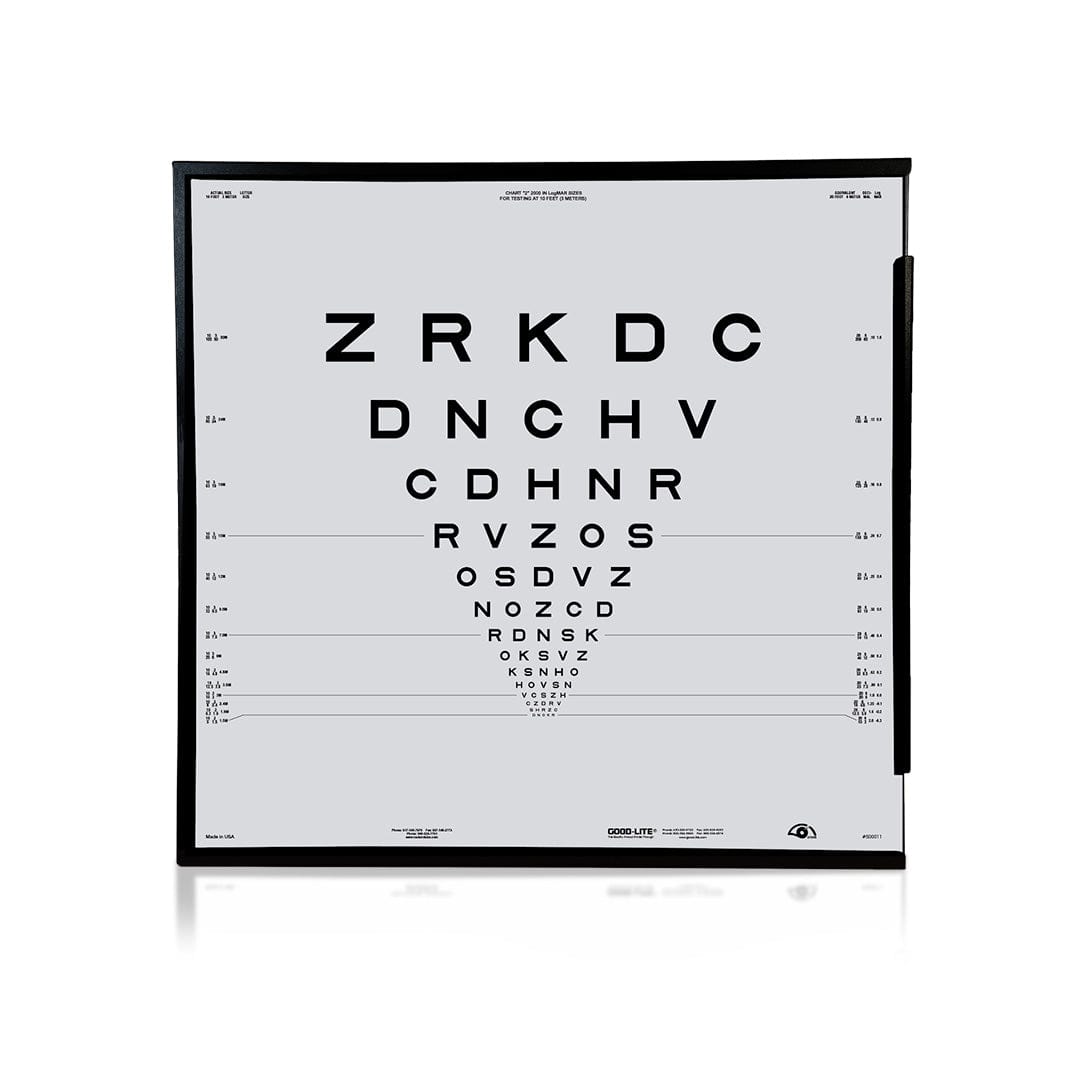
ESV3000™ ETDRS Clinical Trial Standardized Viewer
A self-calibrating ETDRS viewer with preset luminance levels of 3, 85, and 160 cd/m² for research applications requiring defined testing conditions.
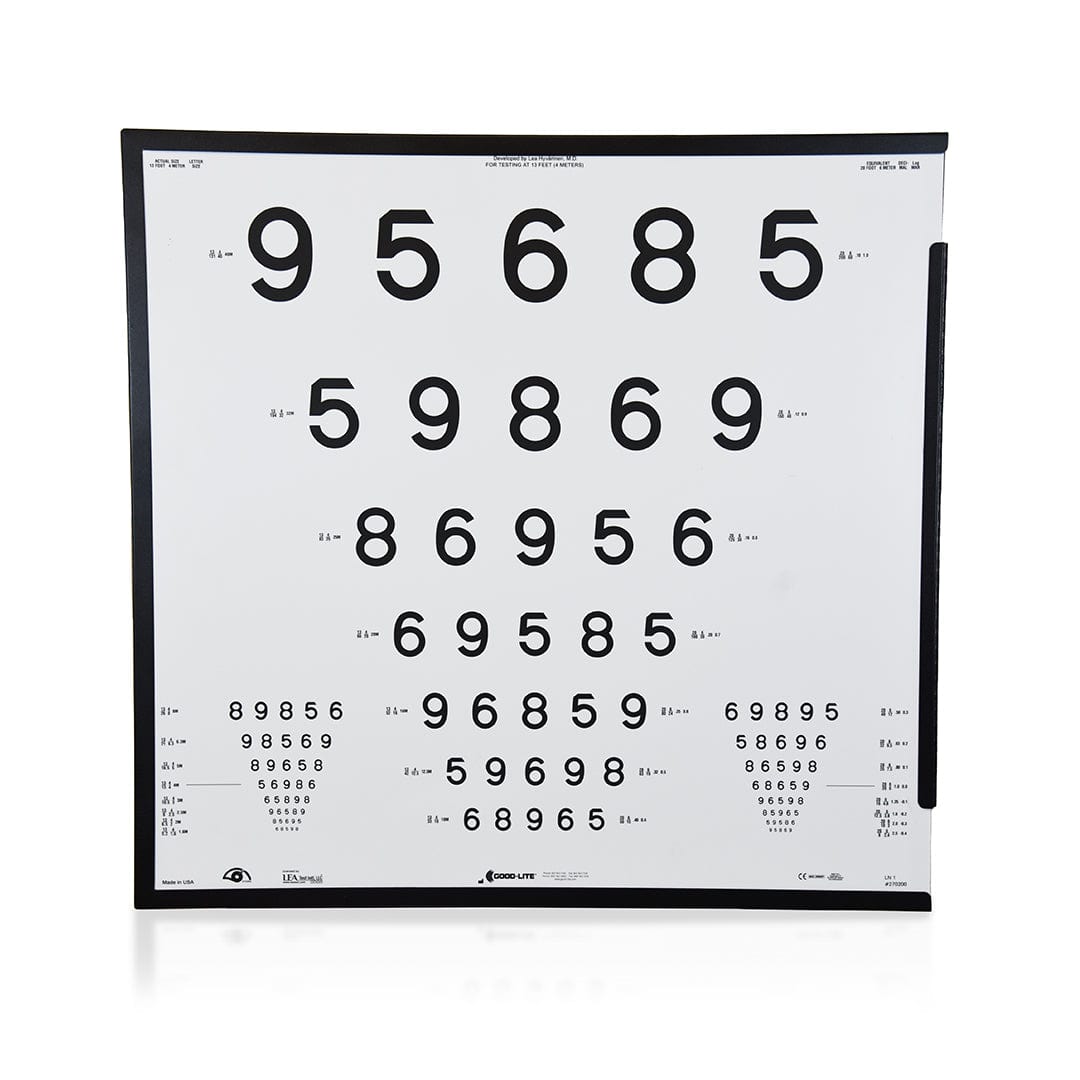
ESC2000™ Illuminated ETDRS Clinical Trial Cabinet
An LED illuminated ETDRS platform available in fixed and adjustable luminance configurations for clinical and research environments.

ETDRS 2000 Series Sloan Letter Chart 1 (13ft/4m)
A Sloan Letter ETDRS chart with proportionally spaced logMAR lines for 13-foot/4-meter testing, compatible with both ESV3000™ and ESC2000™ cabinets.
Confidence in the Result Starts Before the Patient Reads the Chart
Clinical researchers cannot remove every source of variability from visual acuity testing, but they can make deliberate choices about the parts of the method that are under their control. That includes selecting the chart, testing distance, illumination system, scoring procedure, and equipment according to the requirements of the protocol.
This becomes particularly important in multicenter studies. If one location is using a different testing distance, chart format, luminance condition, or equipment configuration from another, those differences can become part of the dataset even though they have nothing to do with the treatment or disease being studied.
Documentation matters for the same reason. Recording the refractive correction, chart and sequence, test distance, scoring method, luminance condition, and presentation system provides context for the acuity value and makes later comparisons easier to interpret.
The most expensive testing system is not automatically the correct one, just as the least expensive system is not automatically the most economical choice. Equipment that exceeds the protocol may add unnecessary complexity, while equipment that cannot reproduce the required conditions can compromise the usefulness of the measurement.
The better approach is to define the test first and select the equipment second. When the chart, illumination system, testing distance, and methodology are chosen as parts of the same protocol, the final visual acuity score carries something more valuable than another number in the study database: greater confidence in how that number was produced.


