




Recent reporting in Georgia has put a familiar school health issue back in focus: children cannot fully benefit from classroom instruction if they cannot see clearly enough to engage with it.
That concern is driving renewed attention to school vision screening, particularly as educators and lawmakers look at reading performance, access to eye care, and whether the current screening system reaches students often enough. The discussion is timely, but it is also important to separate what Georgia schools are required to do now from changes that have been proposed.
Georgia currently requires children entering public school for the first time to submit a completed Department of Public Health Form 3300, which documents vision, hearing, dental, and nutrition screening. In 2026, lawmakers also considered proposals that would have expanded school vision screening to additional grades, but those proposals did not replace the current statewide requirement.
For school nurses and screening programs, the practical challenge remains much the same: understand the requirement that applies today, use age-appropriate screening methods, carry out the procedure consistently, and make sure there is a clear path toward further evaluation when a child does not pass.
Why Georgia is talking about student vision again
The recent KXII and WENG coverage reflects a broader concern about the relationship between vision access and classroom performance. A child who cannot see instructional material clearly may appear distracted, struggle to follow what is happening at the front of the room, or have more difficulty with reading and written work. None of those signs proves that vision is the cause, but they are reasons not to overlook it.
WENG reported on the proposed Georgia Student Vision and Literacy Readiness Act, which would have expanded screening beyond school entry to kindergarten and grades 1, 3, 5, 7, and 10. The bill also proposed a Georgia Vision Access Fund intended to help uninsured and underinsured students obtain eye examinations and glasses.
The official text of HB 1410 included recurring vision screenings, parent notification, referral procedures, screening standards, annual reporting, and creation of the Georgia Vision Access Fund. The proposal drew attention because it addressed not only how often children are screened, but also what happens when a problem is identified and a family still has difficulty reaching follow-up care.
That distinction matters. The expanded schedule received media attention, but it should not be confused with a current statewide mandate.
Current requirement vs. proposed change
Georgia currently requires Form 3300 when a child first enters public school. HB 1410 proposed additional recurring school screenings, but that broader schedule did not become law during the 2025–2026 session.
What Georgia currently requires
The Georgia Department of Public Health states that a parent or guardian enrolling a child in a Georgia public school for the first time must submit a completed Form 3300. The purpose is to identify possible health concerns early enough for families to seek appropriate professional care when further evaluation is needed.
The form documents four screenings:
- Vision
- Hearing
- Dental
- Nutrition
Georgia DPH identifies qualified professionals who may perform the required assessments, including physicians, local health departments, and certain licensed or trained providers depending on the screening. For vision, current DPH guidance identifies distance visual acuity chart testing as the primary method when developmentally appropriate and requires each eye to be screened separately.
The guidance also recognizes that children at different developmental stages may need different testing approaches. Younger children may respond more reliably to LEA SYMBOLS® or HOTV optotypes, while older students are generally able to use Sloan Letters. That makes the choice of chart and response method part of the quality of the screening, not simply a matter of preference.
Good-Lite’s Georgia State Vision Screening Guidelines resource organizes those needs into practical categories and gives schools a place to review state-specific information alongside tools commonly used in school screening programs.
Why screening quality matters as much as screening frequency
The recent policy discussion has focused heavily on how often children should be screened, but frequency is only part of the picture. A program can add more screening dates and still produce poor information if the method is not appropriate for the student being tested or if the procedure is carried out inconsistently.
A younger child who cannot reliably identify random letters may need symbols or matching optotypes instead. Older students may be comfortable with Sloan Letters or other letter-based charts. Correct testing distance, monocular occlusion, clear instructions, appropriate pass criteria, and consistent documentation all matter because small variations in technique can affect how useful the result ultimately is.
That becomes especially important in a school setting, where screenings may be conducted quickly and across large numbers of students. A child who misunderstands the task, peeks around an occluder, stands at the wrong distance, or is given an optotype format that does not match their developmental level may produce a result that reflects the test conditions as much as their vision.
The Georgia State Guidelines page reflects this practical reality by grouping screening needs into visual acuity testing, supporting tools, and other optional components. Those categories include LEA SYMBOLS®, HOTV, Sloan Letters, near vision charts, occluders, measuring cords, response panels, and other accessories that help support a more consistent procedure.
Screening should fit the student
The best screening tool is not simply the most familiar chart. Optotype, distance, occlusion method, response format, and pass criteria should match the age and ability of the student as well as the protocol being followed.
Georgia data shows why follow-up matters
The Georgia Lions Lighthouse Foundation has also reported a substantial need for follow-up care among students reached through its programs. Its 2025 report card shows that from August through December 2024, the organization completed 3,921 school screenings and referred 1,399 students for additional services, representing 36% of the children screened during that period.
During the preceding 2023–2024 school year, 37% of students screened through the foundation’s programs were referred for additional services. Those figures should not be treated as statewide prevalence estimates, because they represent the population reached through a particular screening program rather than a representative sample of all Georgia students.
What the figures do illustrate is how quickly the issue shifts from identification to access. Finding a potential vision problem is useful only if the child can move on to appropriate follow-up, and that next step may depend on transportation, insurance coverage, provider availability, family work schedules, and other practical barriers.
The foundation itself emphasizes that a school screening is not a substitute for a comprehensive eye examination. Its advocacy work has focused on improving access to further care for children who need it, which is an important distinction for schools communicating screening results to families.
That same principle should guide school programs. A failed result should lead to clear communication about what was found, what the screening can and cannot determine, and what kind of follow-up is recommended.
Good-Lite tools that align with Georgia school screening needs
For Georgia schools reviewing their screening setup, Good-Lite offers both complete kits and individual tools that align with the practical needs identified on the Georgia State Guidelines page. The most useful choice depends on the ages being screened, the testing distance, the optotypes being used, and whether the program is building a complete setup or replacing individual components.


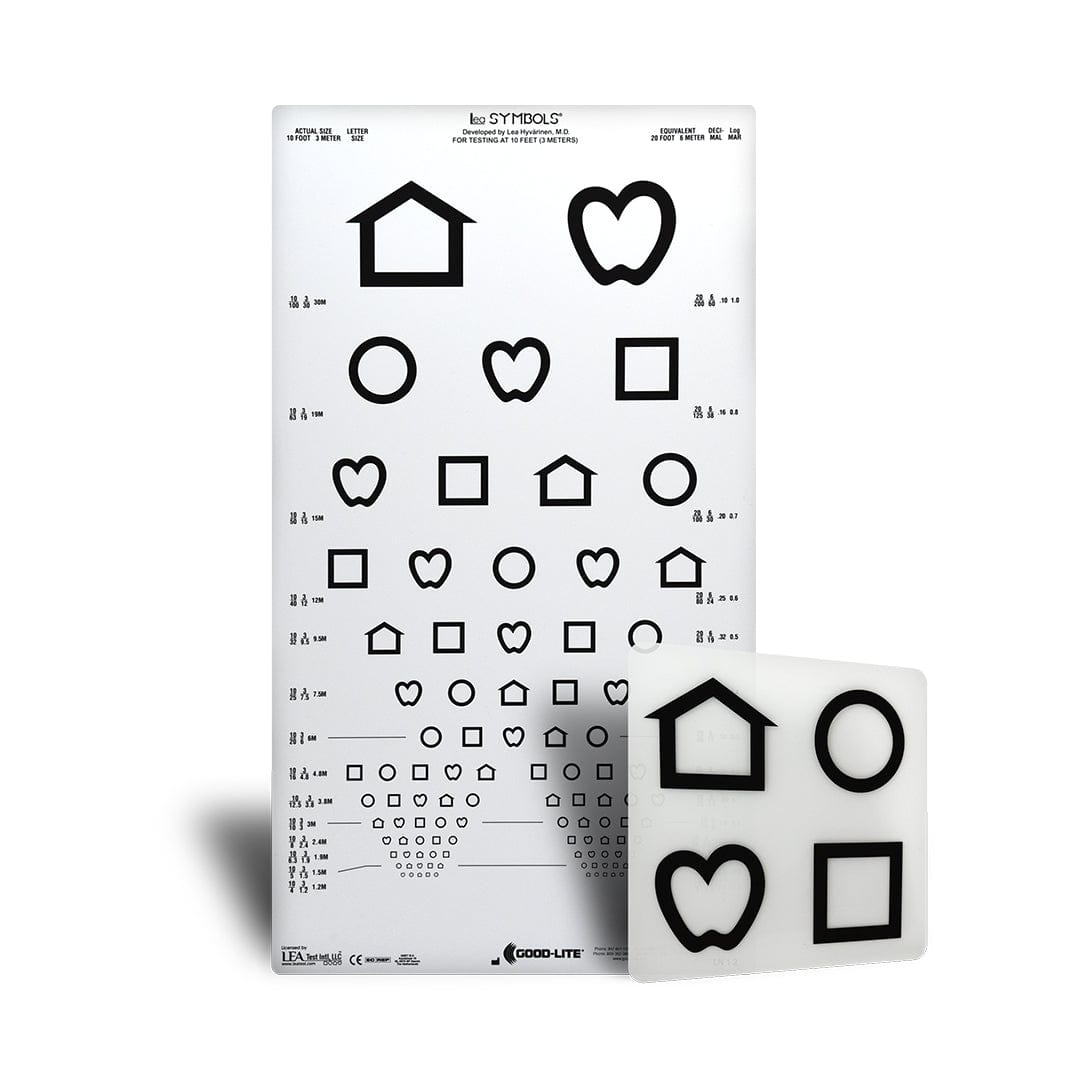
These products address different parts of the same screening process rather than serving as interchangeable versions of one another. A school starting from scratch may benefit from a complete kit, while an established program may only need to replace a chart or add an age-appropriate option for younger children.
Building a screening setup around the requirement
The most useful approach is to begin with the screening protocol rather than the product. For a Georgia school, that means confirming the current state and district requirements, identifying the ages being screened, determining the appropriate test distance and optotypes, and checking that the team has the occlusion, response, and distance-control tools needed to carry out the procedure consistently.
Starting with the protocol also makes it easier to identify what a program genuinely needs. One school may require a complete setup because it is establishing a screening process for the first time, while another may already have most of the necessary equipment and only need to replace or expand certain components.
Good-Lite’s Georgia State Guidelines resource was built for that purpose. It brings together state-specific guidance and relevant screening categories so schools can review the requirement first and then choose tools that fit the way their program actually operates.

Screening is only the first step
The policy discussion in Georgia is likely to continue because the underlying concern has not gone away: some students who need vision care are still identified late, while others face difficulty obtaining the follow-up care they need after a problem has been flagged.
The debate over screening frequency is therefore only one part of the picture. Access to eye examinations, glasses, qualified providers, transportation, and family support all influence whether an identified concern ultimately leads to care.
For school nurses and screening programs, the immediate responsibility is more practical. Use a method that fits the student, follow the current state and local requirements, perform the procedure consistently, document results clearly, and make sure families understand what should happen next when a child does not pass.
A school vision screening cannot diagnose every eye condition or solve every access problem. It can, however, create an earlier opportunity to recognize that a student may not be seeing as clearly as expected and help move that child toward the professional evaluation and care they may need.
Sources
Georgia Department of Public Health. School Health and Form 3300 guidance.
Georgia General Assembly. HB 1410, Georgia Student Vision and Literacy Readiness Act.
Georgia Lions Lighthouse Foundation. 2025 Vision Report Card.
KXII. “How Poor Vision Could Be Impacting Students’ Reading Skills.” September 25, 2026.
WENG Newsroom. “Georgia Bill Would Screen Students’ Eyes Through 10th Grade to Fix Reading Struggles.” September 25, 2026.


